
Renovate or Knockdown Rebuild in Brisbane? A Decision Guide
How Brisbane homeowners can compare renovating, raising and building under, or starting again with a new home — considering character controls, flood requirements, structure, budget, approvals and design potential.
This guide is general information current at the time of writing. Planning rules and requirements change and every property is different — we confirm what applies to your specific site as part of our service.
Deciding whether to renovate your existing Brisbane home or knock it down and rebuild is one of the biggest decisions at the start of a project.
The answer is rarely about cost alone. It depends on the condition and position of the existing house, the planning controls affecting the property, your budget, what you want from the finished home, and whether the existing building provides a good foundation for achieving it.
This guide compares the main considerations so you can better understand what each approach may involve.
Let your site and your wish list work together from the start
Before comparing layouts or deciding what you would prefer to build, check what Brisbane City Plan allows on your property.
Two considerations can have a particularly significant influence:
Traditional Building Character
Brisbane’s Traditional Building Character Overlay applies to identified areas and streets where the traditional pre-1947 streetscape is protected.
If your property is within this overlay and the house was constructed in 1946 or earlier, demolition and external alterations may be subject to additional planning requirements.
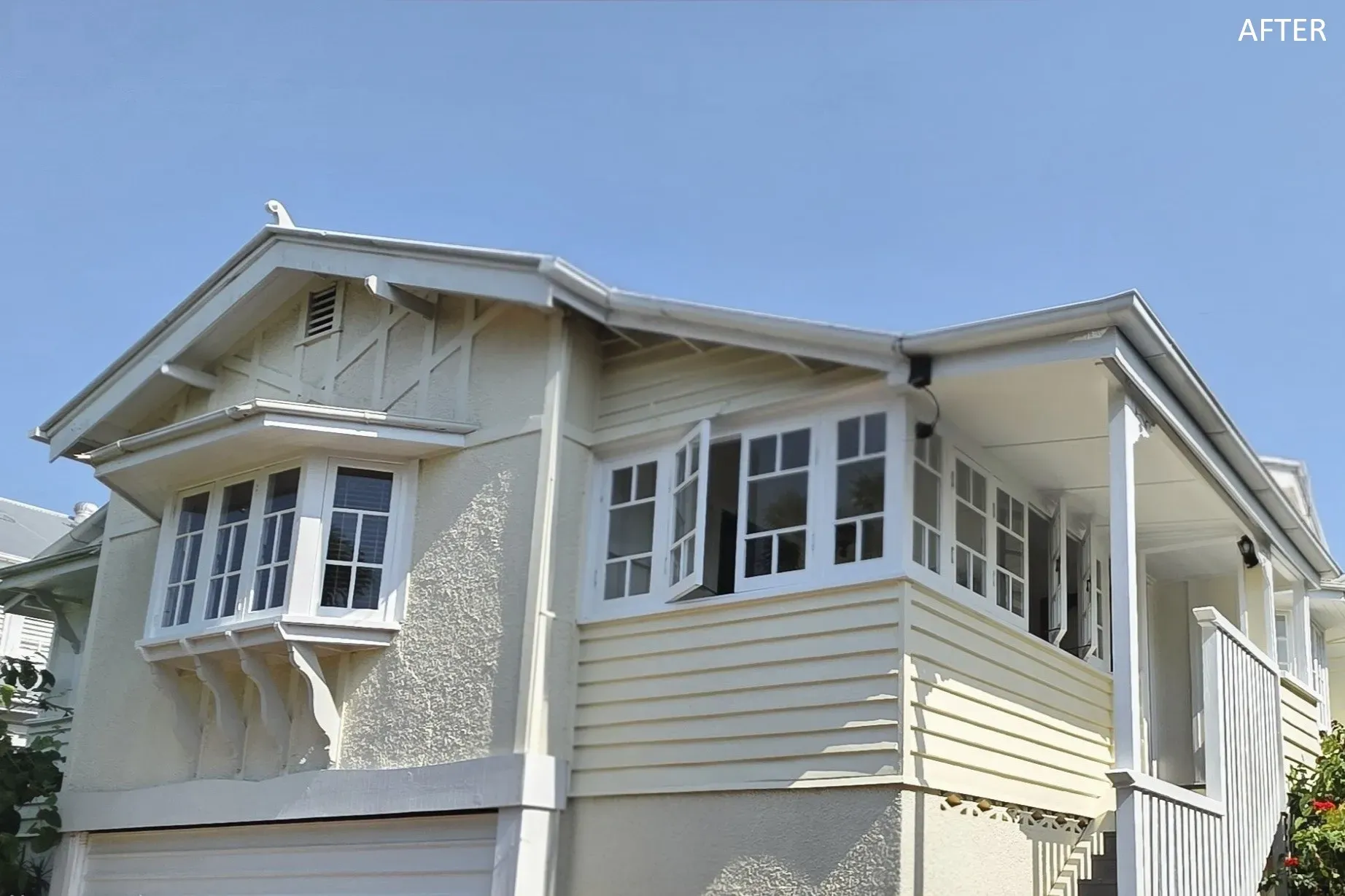
This does not automatically mean the house can never be demolished, or that every renovation requires a DA. The existing building, its construction date, the extent of demolition proposed and the applicable City Plan provisions all need to be considered. A Queenslander renovation can retain its character while adding the space you need.
Official reference: Brisbane City Council — Heritage and character properties and Demolition or removal.
Flood and Overland Flow
Flood planning can influence both renovation and new-home design. For some homes, raising the existing building may provide a practical way of responding to flood constraints; for others, a new home can be designed around the site’s required levels from the outset. Check flood requirements early rather than assuming one approach will be easier — our guide Brisbane Flood Overlays: What They Mean for Your Design explains how to check them.
Understanding these practical constraints early helps you shape a wish list that’s both inspiring and achievable — so you don’t invest in ideas your site won’t support.
Renovate / Raise & Build Under vs Knockdown Rebuild
| Factor | Renovate / Raise & Build Under | Knockdown & Rebuild |
|---|---|---|
| Traditional Building Character | Can retain the existing character home while allowing considered extensions, raising or alterations | Demolition may require planning approval and can be restricted where character controls apply |
| Flood / Overland Flow | Raising may provide an opportunity to move habitable areas above required flood levels | New home can be designed around applicable flood and floor-level requirements |
| Existing structure | Works best where the parts being retained are structurally suitable; existing conditions can introduce unknowns | Starts with an entirely new structure, subject to the site’s existing ground and infrastructure conditions |
| Budget | Can avoid replacing parts of the home that still work, but substantial alterations can introduce construction variables | Requires demolition and a complete new build, but the scope may be easier to define once the design is resolved |
| Approvals | Building Approval is required and planning approval may also be needed depending on the property and design | Demolition requirements need to be checked separately; the new house then requires Building Approval and may also require planning approval |
| Temporary accommodation | Depends on the extent and staging of the work; substantial renovations often require moving out | Generally requires alternative accommodation throughout demolition and construction |
| Design flexibility | Design needs to work with the parts of the existing house being retained | Provides greater freedom to reconsider the entire floor plan, structure and orientation |
| Character retention | Allows original features and the identity of the existing home to form part of the finished design | New home with flexibility on style and character |
| Site response | Can take advantage of an existing house that is already well positioned on the block | Provides an opportunity to reconsider the building’s position and relationship to the site, subject to planning and building requirements |
How we help you decide
We take a feasibility-led approach.
We start by understanding what you want from the finished home, then review the existing building and the planning controls affecting the property.
From there, we can identify whether the existing home provides a strong foundation for renovation, whether raising or extending presents opportunities, or whether starting again with a new home deserves further investigation.
The aim is to establish a design direction with a clear understanding of the site’s opportunities, constraints and approval pathway before moving into detailed design.
Frequently Asked Questions
Is it cheaper to renovate or knock down and rebuild in Brisbane?
Neither is automatically cheaper. A renovation that retains substantial portions of a suitable existing home can avoid rebuilding areas that already work. However, major structural alterations, older services and unforeseen existing conditions can increase complexity. A knockdown rebuild involves demolition and construction of an entirely new home, but the scope can be more clearly defined once the design and site requirements are understood. A meaningful comparison needs to consider what each option would require to achieve a similar finished brief.
Can I knock down a pre-1947 house in Brisbane?
It depends on the property. If the house is within Brisbane's Traditional Building Character Overlay and was constructed in 1946 or earlier, demolition may require planning approval and is assessed against the relevant City Plan requirements. There are also separate controls for heritage properties, pre-1911 buildings and some neighbourhood plan areas. Check the property's overlays and demolition requirements before assuming the existing house can be removed.
How does a flood overlay affect the decision?
Flood requirements can influence floor levels, building configuration and how different parts of a home can be used. The FloodWise Property Report can identify applicable flood planning areas and, where available, the minimum habitable floor level for the property. Raising an existing house can sometimes provide an effective response, while a new home can be designed around the required levels from the beginning. Neither option should be assumed to be preferable until the property-specific flood information is reviewed.
Do I need a DA to renovate?
Not always. Extensions, raising and renovations require Building Approval, while separate planning approval depends on the property and proposed work. Planning approval may be required where the design does not meet applicable City Plan requirements or where additional controls such as the Traditional Building Character Overlay or a neighbourhood plan apply.
Do I need a DA for a knockdown rebuild?
There are two separate questions. First, check whether planning approval is required to demolish the existing house. Second, check whether the proposed new house requires planning approval. Even where demolition is permitted, the new home still needs to comply with the planning and building requirements applying to the property.